





Curiosity Is a Longevity Practice
Explore why curiosity may support a longer, healthier life.
Key Takeaways:
- Higher levels of curiosity are associated with greater longevity, with studies showing that older adults who were more curious were more likely to live longer.
- Maintaining curiosity may help protect against cognitive decline, emotional challenges, and certain age-related diseases.
- A person’s perception of how much time they have left in life can influence how motivated they feel to pursue curiosity and learning.
- Creating regular opportunities for exploration, learning, and wonder could help sustain curiosity and support both lifespan and healthspan.
Even though it may seem like a recent fixation, longevity has been on our minds since ancient history. They may not have had modern drugs and supplements at their disposal, but many in long-past civilizations explored varied ways to prolong life. For rulers in ancient China, alchemists concocted immortality elixirs that contained mercury and other metals, which may have sounded enticing. That is, until Emperor Qin Shi Huang and others reportedly started dying from them. This anti-aging obsession continues today in China where, as The New York Times reported, “‘immortality islands’ and grapeseed pills” aim to keep people forever young.
Of course, China’s hardly alone in pursuing novel ways to extend one’s life, with people around the world exploring methods ranging from the dubious to the tried-and-true, like eating healthier and exercising more.
But what if there has always been something within us—something inherent to the way many of us already perceive the world—that can extend our longevity, too?
That something, scientists say, is curiosity.
How does curiosity affect longevity?
Toward the end of the 20th century, a pair of scientists from the research and development institute SRI International in Silicon Valley embarked on an ambitious study. They measured the curiosity levels in more than 1,100 older men with an average age of 71 years old. Then, five years later, they checked to see who was still alive.
The researchers assessed two different kinds of curiosity: trait curiosity, or one’s consistent, intrinsic desire to seek new knowledge and experiences, and state curiosity, or a temporary state of knowledge-seeking prompted by specific situations or stimuli.
What they found was telling: The initial levels of both types of curiosity had been higher in those who’d survived than those who’d died during those five years. And it wasn’t just a male phenomenon: A separate analysis of more than 1,000 older women revealed similar results.
As the researchers wrote in the journal Psychology and Aging, it was “the first study to identify a predictive role for curiosity in the longevity of older adults.”
Ever since, scientists have explored a paradox: Even though research has historically shown that curiosity tends to decline as we age, curiosity is also increasingly important to our health as we get older.
A review of literature in this area, published in the journal Neuroscience & Biobehavioral Reviews, found that while aging is tied to a drop in curiosity, those who preserve their curiosity levels are more protected against cognitive and physical decline, as well as against hits to one’s emotional wellbeing. They connected this effect to two areas of the brain that process our curious thoughts.
How does curiosity change as we age?
As a study from 2020 pointed out, many researchers have found a negative relationship between age and curiosity. Basically, we tend to get less curious about the world as we get older. But what does that mean, exactly? Curiosity can take different forms: situational, perceptual, and, perhaps most commonly, intellectual. Why might scientists be seeing this phenomenon over and over again?
The researchers who conducted that 2020 study of more than 850 individuals across several cultures aimed to find out. They focused on the most widely understood form of curiosity—intellectual—and found that the perception of diminishing “future time,” or the time remaining in one’s life, was connected to drops in curiosity, regardless of one’s age at that particular moment. In other words, if someone didn’t feel like they had much future time remaining, it “reduce[d] the tendency to invest time and resources to form or resolve intellectual curiosity.”
So it’s not that people aren’t curious as they age; it’s that they, perhaps subconsciously, wonder if exploring their curiosity as they age is a good use of their time. And a recent study from a group of international psychologists makes a pretty compelling case that it is.
Remember those two subtypes of curiosity, trait and state? Well, like other scientists, the psychologists found that trait curiosity—the permanent kind—declines with age. They measured this characteristic through responses to a questionnaire.
But the temporary, and less frequently studied, kind of curiosity—state curiosity—actually increased with age. They assessed state curiosity by posing trivia questions to the more than 200 study participants and discovered that, while older adults may not seek out new information as much as their younger peers, when prompted with materials and opportunities to learn, they are often more engaged than others. This finding contradicts the widely held belief that one’s curiosity is a dwindling trait in old age.
And it’s not just one’s knowledge that can increase with this shift in curiosity. The researchers believe that older adults who continue preserving this aspect of their personality may be able to combat the negative effects of, or even prevent, Alzheimer’s disease. And those who don’t may be at a higher risk of dementia.
So it’s not just one’s lifespan that can benefit from heightened curiosity. It’s their healthspan, too.
How to practice curiosity
There are many research-backed ways to build our curiosity. But for those who struggle to form habits of proactively asking questions or journaling about their sense of wonder, there is another way to experience all the physical, psychological, and emotional benefits of state curiosity without having to do it all on their own.
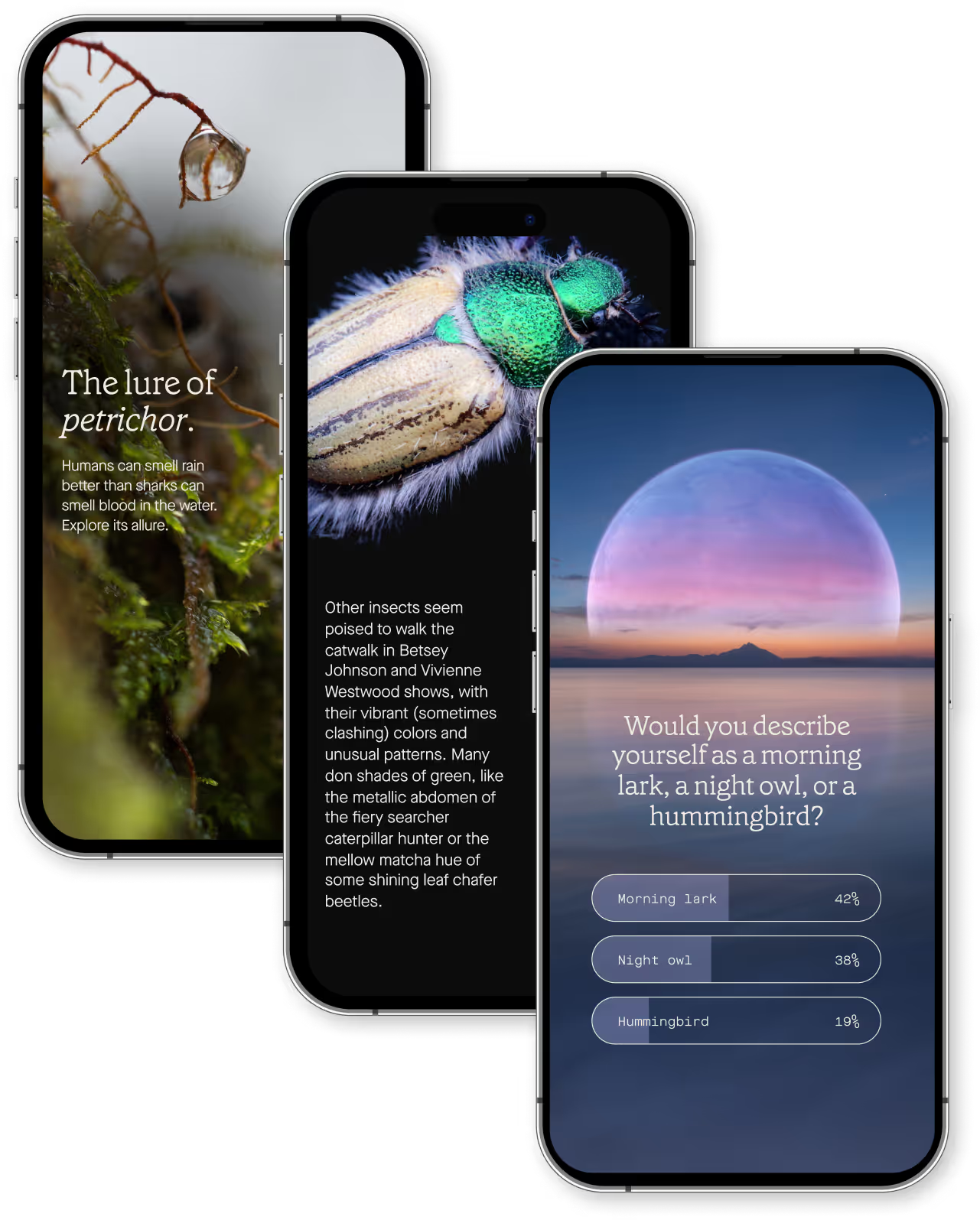
The Humane Space app provides meaningful activities to spark your curiosity, all based on the latest research. From lifelong learning to guided visualization to mindful awe walks, we’ll help you create a daily ritual of curiosity and wonder.
So go ahead and allow yourself to indulge that curiosity. If you do, you might have more “future time” ahead than you think.
References
Burman, Edward. “The Art of Not Dying.” Lapham’s Quarterly, 8 Aug. 2018, www.laphamsquarterly.org/roundtable/art-not-dying.
Chu, Li, et al. "Association between Age and Intellectual Curiosity: The Mediating Roles of Future Time Perspective and Importance of Curiosity." European Journal of Ageing, vol. 18, no. 1, 27 Apr. 2020, pp. 45–53, link.springer.com/article/10.1007/s10433-020-00567-6.
Ducharme, Jamie. “The Dark Side of Biohacking.” Boston Magazine, 30 Jan. 2026, www.bostonmagazine.com/health/2026/01/30/dark-side-biohacking-immortality-trap/.
Higgins, Andrew. “In China, the Dream of Outrunning Time.” The New York TImes, 11 Nov. 2025. https://www.nytimes.com/2025/11/08/world/asia/china-aging-longevity-science.html.
Ober, Holly. “Are You Curious? How It Might Help You Stay Sharp as You Age.” UCLA, 7 May 2025, newsroom.ucla.edu/releases/curiosity-can-help-brain-stay-sharp-as-they-age.
Sakaki, Michiko, Ayano Yagi, and Kou Murayama. “Curiosity in Old Age: A Possible Key to Achieving Adaptive Aging.” Neuroscience & Biobehavioral Reviews, vol. 88, May 2018, pp. 106–116, doi.org/10.1016/j.neubiorev.2018.03.007.
Swan, Gary E., and Dorit Carmelli. “Curiosity and Mortality in Aging Adults: A 5-Year Follow-Up of the Western Collaborative Group Study.” Psychology and Aging, vol. 11, no. 3, 1996, pp. 449–53, doi.org/10.1037/0882-7974.11.3.449.
Whatley, Mary C., et al. “Curiosity across the Adult Lifespan: Age-Related Differences in State and Trait Curiosity.” PLoS ONE, vol. 20, no. 5, 2025, doi.org/10.1371/journal.pone.0320600.
Make curiosity a daily ritual.
7 days free.
Want to keep your mind curious?