






Cultivating a Curious Mind in Conversation
See how curiosity can shift even tough conversations.
Key Takeaways:
- Deeper, more substantive conversations are linked to higher happiness than frequent small talk.
- Curiosity and variety keep conversations engaging and enjoyable for both parties.
- Effective conversationalists listen for what’s said and unsaid, adjusting when attention wanes.
- Approaching sensitive topics with curiosity rather than persuasion fosters mutual understanding.
- Open-ended questions and meaningful props can naturally lead conversations to richer ground.
Why should conversations go beyond small talk?
We’ve all been there: You’re at a holiday party, and the conversation has grown dry. You’ve already asked about jobs, kids, and who brought the bean dip. The weather is on the horizon.
Small talk starts with good intentions. By asking about predictable topics, we’re signaling that we want to make our conversational partners feel comfortable. And sometimes, that’s enough.
But these conversations don’t bring us closer. To forge deeper connections with friends and loved ones, we need to sustain our interest—and others’—in conversations. And being a good conversationalist isn’t just for our social benefit. Science says it makes us feel better. One study of 79 college students wearing audio recorders found that those who talked more and spent less time alone were happier than their peers. Critically, the happiest students engaged in far less small talk, and far more substantive conversations, than the unhappiest students.
How do you keep the conversation going?
Small talk can be a starting point for building close relationships. Brain hyperscans (a neuroimaging technique used to record brain activity from two people simultaneously) have revealed that it can foster brain synchrony, when similar areas of different people’s minds activate or disengage simultaneously.
But pretty quickly, most people seek novelty in conversation to hold their attention.
In one recent study, friends didn’t stay stuck in small talk. They conversed about a wide range of topics, keeping their conversational partners surprised and engaged. And as a result, they enjoyed their conversations more than most strangers.
The strangers who did appreciate their exchanges sounded like friends. Their conversations started with basic questions but quickly progressed to different topics. After a synchronous period, their neural patterns diverged significantly, just like the friends’ did.
Still, it’s possible to diverge too much. If a topic is beyond a listener’s understanding, they’ll lose interest in the conversation. The key to keeping the discussion going, according to researchers in the journal Current Directions in Psychological Science, is to introduce new ideas while also periodically checking to make sure listeners are still following along. If the listener is lost, the speaker must circle back to a place of understanding.
Being a good conversationalist, then, isn’t just listening to what someone is saying. It’s hearing what they’re not saying and adjusting accordingly.

How can curiosity save conversations?
Many of us receive guidance from a young age to avoid broaching potentially divisive topics in conversation, even with those closest to us. Touchy subjects like politics, we’re told, can derail otherwise pleasant family gatherings during the holiday season.
This advice is not wrong, necessarily. But oftentimes, our approach to these chats is self-fulfilling. Instead of seeking to understand where our friends and family members are coming from, many of us try to persuade them that we’re right.
What might we gain by cultivating genuine curiosity about others’ perspectives? The same researchers who studied the brain behavior of friends and strangers in conversation looked at the minds of those entering political discussions seeking to compromise versus those seeking to persuade. In unpublished research, they found that those looking to compromise explored more subjects and arrived at a greater consensus than those merely debating their points of view.
By embracing a mindset of curiosity, they could learn more from their conversational partners and expand what they could accomplish together.
What are some simple ways to be a better conversationalist?
It takes two to engage in enriching discussion, so it’s not all on you to keep the conversation going. But you can lead the way by:
- Asking better questions. You don’t have to skip “how are you?”, but more specific, open-ended questions will broaden the discussion. Try: “What’s something you learned recently that changed your perspective?” “What’s something you’re curious about now?” “What’s a decision you made this year that you feel good about?”
- Listening while speaking. It’s great to tell stories and cover new ground in conversation. But paying attention to how your listener responds is key to maintaining emotional engagement. Observe their nonverbal cues (nodding, eye contact) and redirect the conversation if you sense you’ve lost them.
- Using a prop. Show-and-tell doesn’t just have to be for kids. Talk about an item of importance to you or an object you discovered while traveling. This is bound to take your conversation to unexpected places.
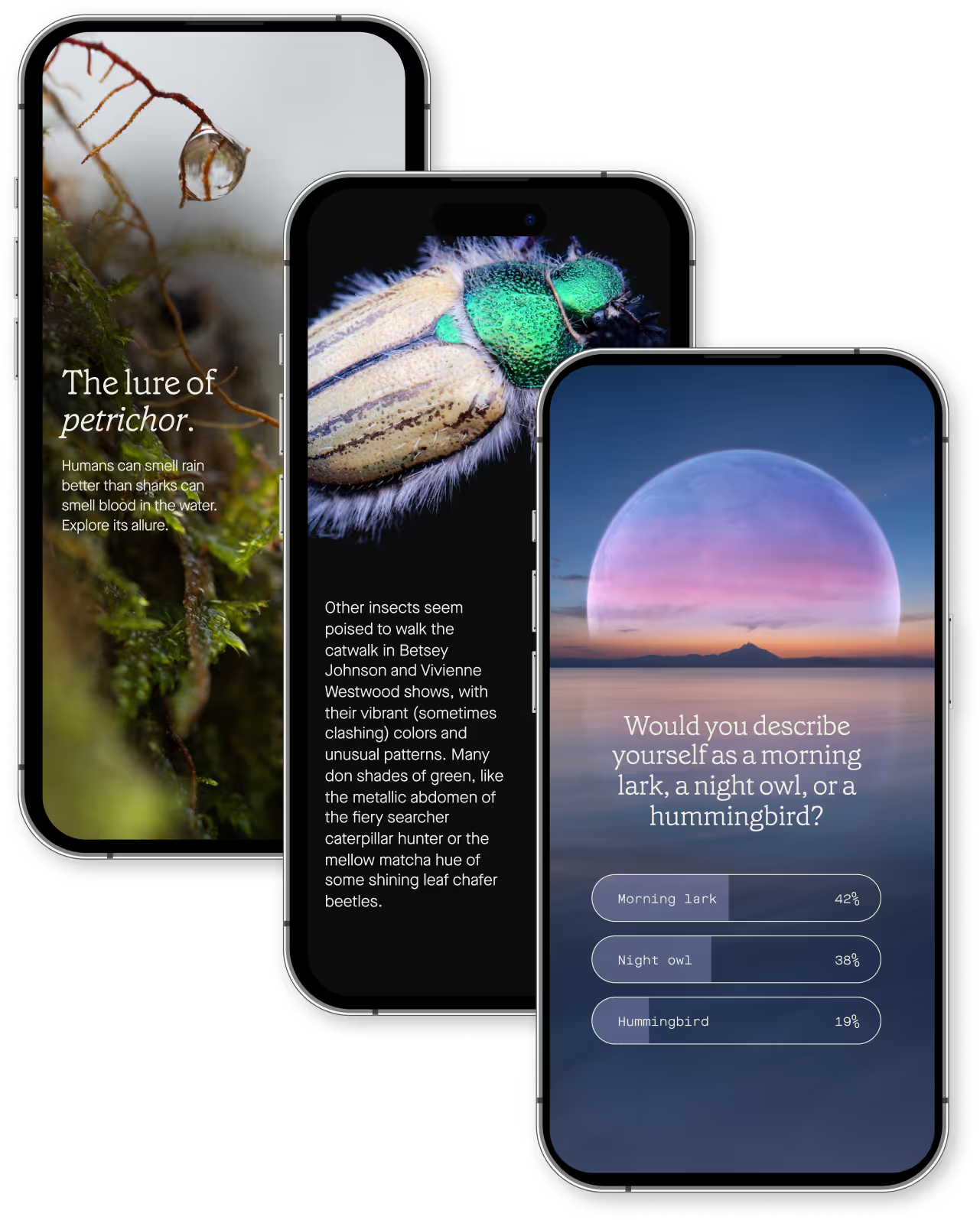
- Raising a topic you’re curious about. Visit The Humane Space to dive into awe-inspiring subjects ranging from science to art to history. If a topic on the app captures your attention, there’s a good chance it will hold someone else’s, too.
References
Burns, Shannon M., et al. “Interdependent Minds: Quantifying the Dynamics of Successful Social Interaction.” Current Directions in Psychological Science, vol. 34, no. 5, 2025, www.pmc.ncbi.nlm.nih.gov/articles/PMC12366877/.
Falk, Emily. “Good Conversations Don’t Require Everybody to Agree, Neuroscience Shows.” Scientific American, 25 Sept. 2025, www.scientificamerican.com/article/good-conversations-dont-require-everybody-to-agree-neuroscience-shows/.
“Great Questions.” StoryCorps, storycorps.org/participate/great-questions/.
Mehl, Matthias R., et al. “Eavesdropping on Happiness: Well-Being Is Related to Having Less Small Talk and More Substantive Conversations.” Psychological Science, vol. 21, no. 4, 2010, pmc.ncbi.nlm.nih.gov/articles/PMC2861779/.
Mogan, Reneeta, et al. “To Be in Synchrony or Not? A Meta-Analysis of Synchrony's Effects on Behavior, Perception, Cognition, and Affect.” Journal of Experimental Social Psychology, vol. 72, 2017, www.sciencedirect.com/science/article/abs/pii/S0022103116306114?via%3Dihub.
“Princeton Social Neuroscience Lab.” Princeton University, psnlab.princeton.edu/research.
Schmälzle, Ralf, et al. “Engaged Listeners: Shared Neural Processing of Powerful Political Speeches.” Social Cognitive and Affective Neuroscience, vol. 10, no. 8, 2015, pubmed.ncbi.nlm.nih.gov/25653012/.
Speer, Sebastian P. H., et al. “Hyperscanning Shows Friends Explore and Strangers Converge in Conversation.” Nature Communications, vol. 15, no. 7781, 2024, www.nature.com/articles/s41467-024-51990-7.
Umberson, Debra and Jennifer Karas Montez. “Social Relationships and Health: A Flashpoint for Health Policy.” Journal of Health and Social Behavior, vol. 51, 2010, pmc.ncbi.nlm.nih.gov/articles/PMC3150158/.
Make curiosity a daily ritual.
7 days free.
Want to keep your mind curious?