







What is an Awe Walk?
Taking an Awe Walk can boost your mental and physical health.
Key Takeaways:
- An Awe Walk is a walk taken with the intention of experiencing awe or wonder by paying closer attention to your surroundings.
- Research suggests that Awe Walks can increase positive emotions, reduce distress, and support overall well-being.
- Awe can be inspired by both extraordinary sights and ordinary details, from towering trees to intricate patterns in nature or architecture.
- To take an Awe Walk, slow your pace, engage your senses, observe familiar surroundings with fresh eyes, and linger on anything that sparks curiosity.
- Awe Walks can happen almost anywhere, and the goal is not to force a profound experience but to become more attentive and open to wonder.
We walk for many reasons: to reach a destination, to exercise, to think.
But how many of us walk to experience a sense of wonder?
When we’re moving through the world, it’s easy to speed past things that might surprise us, move us, or expand our understanding of what’s around us. An Awe Walk asks us to slow down, pay closer attention, and notice what we might otherwise miss.
What is an Awe Walk?
An Awe Walk is a walk that begins with the intention of experiencing awe or wonder.
But what is awe, exactly? Researchers describe awe as a response to something that feels vast and challenges our existing understanding of the world. Encountering a giant redwood tree, considering the origins of the constellations above, or witnessing an unexpected act of kindness may all inspire awe. So, too, can intricate patterns, music, architecture, history, and collective human effort.
The point of an Awe Walk isn’t exercise or relaxation, though both may be welcome side effects. It’s to shift your attention toward wonder. In the Pulitzer Prize-winning book, Pilgrim at Tinker Creek, Annie Dillard reflects on the power of walking every day in the Blue Ridge Mountains of Virginia and observing her surroundings. One time, she watched the daring flight of a mockingbird:
“I had just rounded a corner when his insouciant step caught my eye; no one else was in sight. The fact of his free fall was like the old philosophical conundrum about the tree that falls in the forest. The answer must be, I think, that beauty and grace are performed whether or not we will or sense them. The least we can do is try to be there.”
An Awe Walk is being there.
What are the benefits of an Awe Walk?
In 2020, researchers at the UC San Francisco Memory and Aging Center and the Global Brain Health Institute (GBHI) conducted a study on Awe Walks. For eight weeks, two groups of older adults went on 15-minute outdoor walks every week. Researchers advised one group to try to experience awe during their walks. The control group didn’t receive the awe prompt.
The Awe Walk group reported greater increases in positive emotions and decreases in distress over the course of the study. In photos, the Awe Walk group smiled wider and appeared smaller, taking up less space in the photos relative to their surroundings—signs of experiencing a “small self” in the presence of vastness.
A growing body of research has examined how experiences of awe may affect well-being. A review conducted by a pair of University of California, Berkeley researchers found in 2022 that awe “engages five processes—shifts in neurophysiology, a diminished focus on the self, increased prosocial relationality, greater social integration, and a heightened sense of meaning—that benefit well-being.” A 2023 study also linked everyday experiences of awe with improvements in stress, somatic health, and well-being.

How to take an Awe Walk
Choose a place where you can wander without too many distractions.
You don’t need to travel far to embark on an Awe Walk. Returning to the same park, garden, or city street where you’ve strolled before is perfectly fine, as long as you have the space to roam and think without interruption. Choose somewhere you can walk safely and give your surroundings your full attention.
Awaken your senses.
Just as you might stretch before exercising, taking a moment to tune into your senses can help bring your attention into the present. Begin walking slowly and don’t worry about your speed. Instead, focus on the feeling of your feet against the ground, the movement of air across your body, the different shades of color in front of you. Listen to the world around you and track the rhythm of your breathing.
Shift between the big picture and the smallest details.
Let your attention move between scales. Look up at the sweep of a tree canopy or skyline, then closer at the veins of a leaf, the texture of bark, or the pattern in a building facade. Awe can come from enormity, but it can also come from intricacy.
Look at something familiar with new eyes.
Over time, familiarity can stop us from looking closely. Try questioning something you normally pass without noticing: How old might that tree be? How many people have sat on that bench? What colors are actually present in a pigeon’s feathers?
Linger for an extra beat before moving on.
An Awe Walk is the opposite of a race. If something catches your attention, stay with it for a little longer than you normally would. Resist the impulse to move on immediately. Give yourself permission to linger.
Bring one observation home.
You don’t need to leave an Awe Walk with a profound realization. If it’s helpful, jot down one thing that surprised you, made you feel small, or expanded your understanding of the world. A consistent awe practice will build on these insights over time.
Where can you take an Awe Walk?
You don’t need a mountaintop or a national park. An Awe Walk can happen on a residential block, inside a museum, through a public garden, along a waterfront, or on the route you take every morning.
New places naturally give our attention more to work with, but familiarity has an advantage too: It lets us notice what has changed. All it takes is a shift in attention—when you take time to notice the seasonal changes, creative flourishes, and feats of humanity happening around us all the time, even the familiar can feel fresh.
What if you don’t experience awe?
Awe isn’t something you can force, and an Awe Walk doesn’t have to produce a profound moment. The practice is really about making yourself more available to wonder. You might notice an unusual pattern of light, become curious about a tree you’ve passed a hundred times, or simply feel a little more present in your surroundings. That’s enough. The goal is attention, not a particular emotional outcome.
Making awe part of everyday life
There is truly no limit to the sights, sounds, and other phenomena that can elicit awe. Trying a short Awe Walk near home is a great way to experience this firsthand. Even a small stretch of street can suddenly feel awe-inspiring, for instance, when you appreciate the care and beauty of a neighbor’s garden.
Awe doesn’t require a spectacular destination. Often, it begins with giving ordinary things more of our attention.
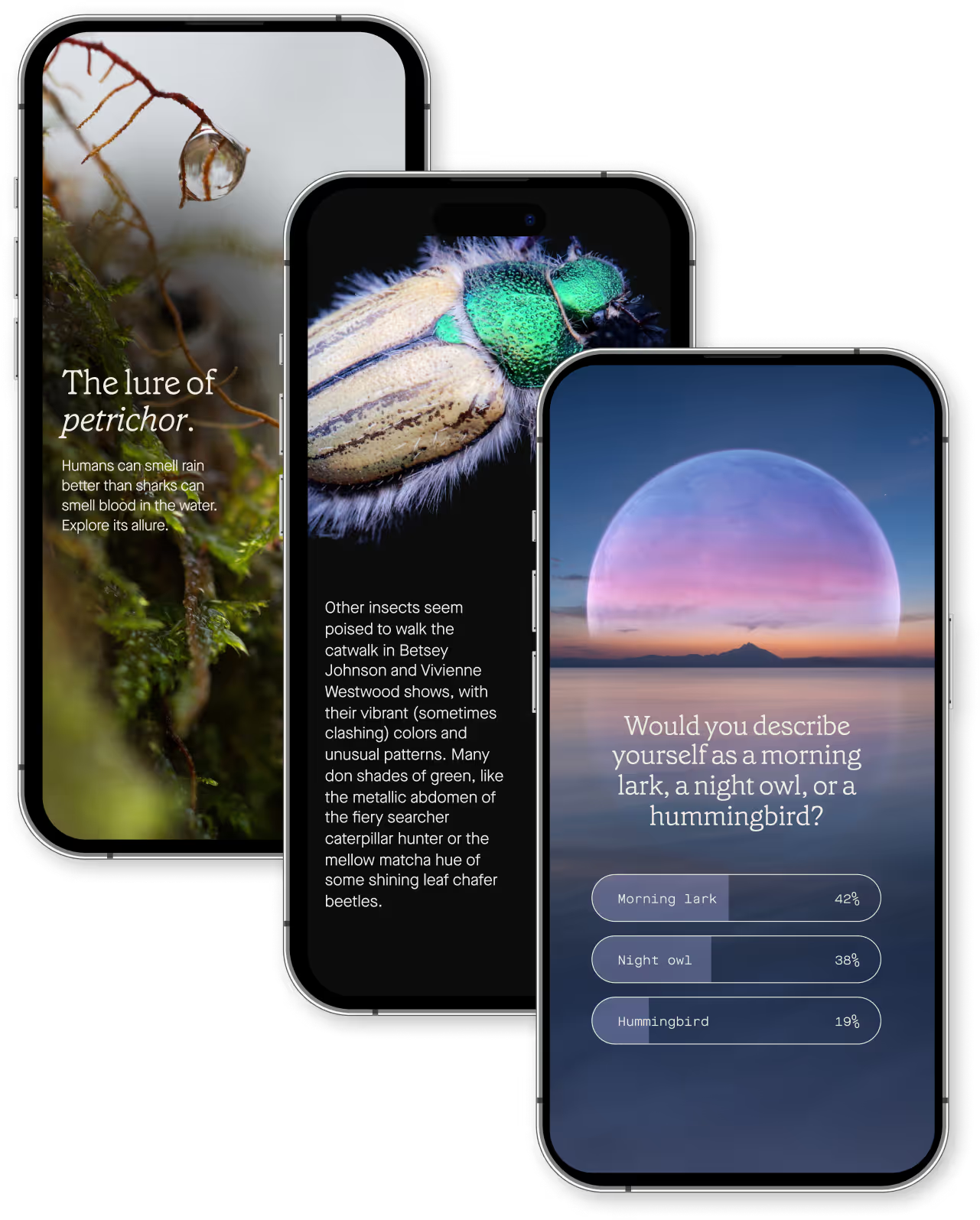
If you need a little help getting started, The Humane Space offers a library of guided Awe Walks that help you slow down, notice more, and make wonder part of everyday life.
References
Dillard, Annie. Pilgrim at Tinker Creek. Bantam Books, 1978.
Friedlaender, Diane. “Take an ‘Awe Walk’: The Benefits of Walking with Presence.” Stanford Lifestyle Medicine, Stanford University, 24 Mar. 2026, lifestylemedicine.stanford.edu/awe_walk_gratitude/.
Keltner, Dacher, and Jonathan Haidt. “Approaching Awe, a Moral, Spiritual, and Aesthetic Emotion.” Cognition and Emotion, vol. 17, no. 2, 2003, pp. 297–314, doi.org/10.1080/02699930302297.
Keltner, Dacher. “How to Cultivate Awe With a Walking Meditation.” Greater Good Science Center, 24 Apr. 2017, greatergood.berkeley.edu/article/item/how_to_cultivate_awe_walking_meditation.
Monroy, María, and Dacher Keltner. “Awe as a Pathway to Mental and Physical Health.” Perspectives on Psychological Science, vol. 18, no. 2, 2023, pp. 309–320, doi.org/10.1177/17456916221094856.
Monroy, María, et al. “The Influences of Daily Experiences of Awe on Stress, Somatic Health, and Well-Being: A Longitudinal Study during COVID-19.” Scientific Reports, vol. 13, 2023, doi.org/10.1038/s41598-023-35200-w.
Sturm, Virginia E., et al. “Big Smile, Small Self: Awe Walks Promote Prosocial Positive Emotions in Older Adults.” Emotion, vol. 22, no. 5, 2020, pp. 1044–1058, doi.org/10.1037/emo0000876.
Make curiosity a daily ritual.
7 days free.
Want to keep your mind curious?