


Mindful Learning is the Antidote to Digital Fatigue
Feeling distracted or drained by endless scrolling? Mindful learning helps you reconnect with what really matters.
Key Takeaways:
- Mindless scrolling and passive content consumption can increase anxiety, while mindful learning helps restore agency, curiosity, and emotional balance.
- Mindful learning encourages present-moment awareness and self-directed exploration, reducing reliance on external algorithms for information.
- Studies show mindfulness improves focus and executive attention, benefiting learners of all ages—not just students in formal settings.
- Mindful learners show better emotional regulation and are neurologically more prepared to handle stress and negative stimuli.
- This approach enhances memory by reducing interference from past learning and improving verbal information retention, including language acquisition.
We’ve all been there: late at night, doomscrolling on the internet, unable to sleep. More information is at our fingertips than ever before, yet we feel like we have less control over what we read, hear, and see. And it’s making us feel worse.
During the COVID pandemic, researchers found that those who read their newsfeeds more were more likely to experience anxiety and depression. And this digital activity didn’t have to be intentional to be harmful: Another study found that even passive social media use among college students was negatively correlated with their subjective well-being; in other words, the more they scrolled, no matter how aimlessly, the more likely they were to be feeling unwell.
Some of those researchers later found that avoiding distressing news helped improve mental health. But how do we balance filtering what we consume with fulfilling our curiosity?
The answer is mindful learning.
What is mindful learning?
Mindful learning is a state of present, open, nonjudgmental, and curious exploration. As scholars have observed, it’s the opposite of operating on “autopilot”; it requires deep immersion and engagement with the topic at hand. Instead of letting someone else—or an algorithm—dictate what and how they should consume information, mindful learners follow their curiosity, inviting wonder and awe.
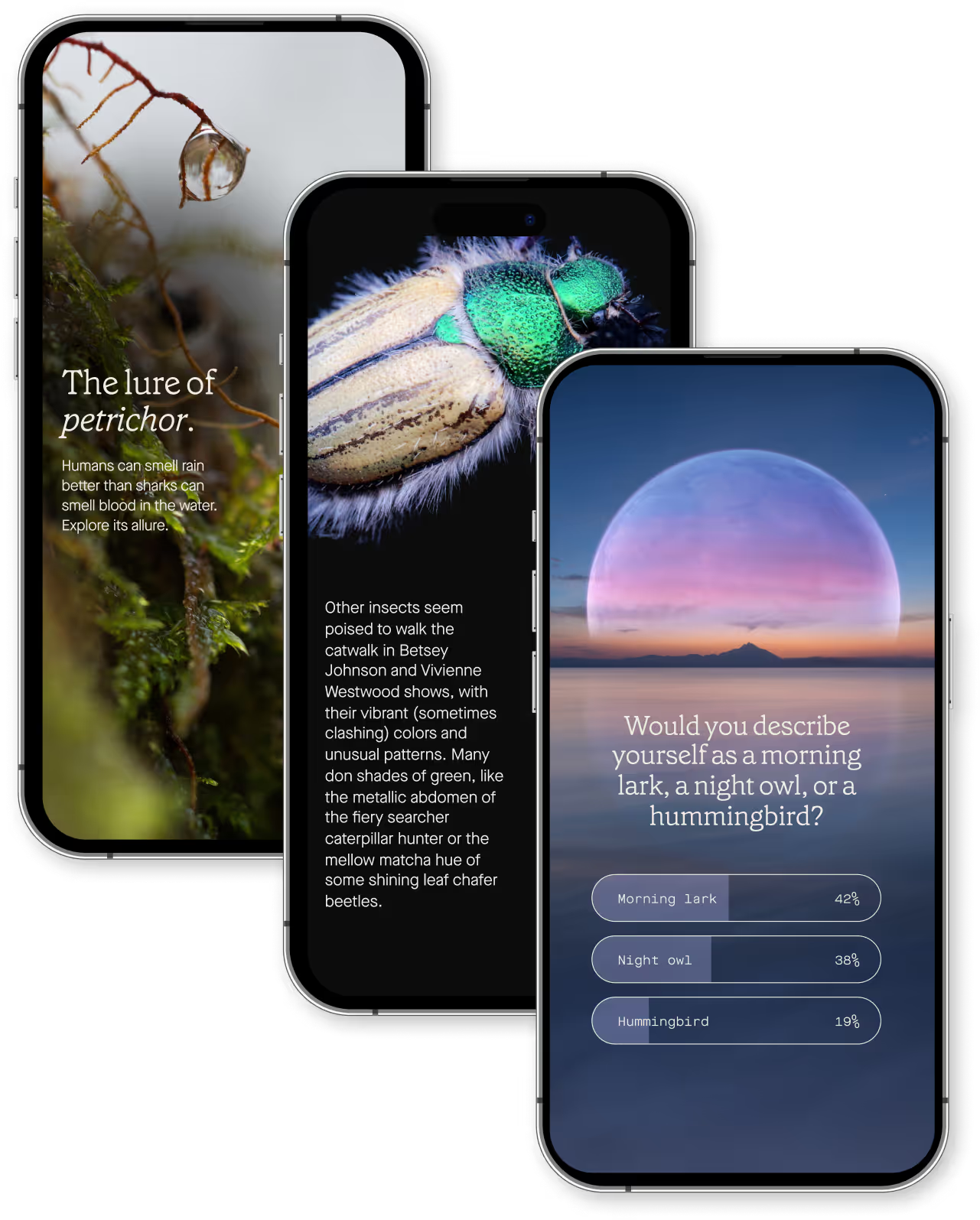
The Humane Space app, for example, provides deep-dives on hundreds of subjects, from neuroscience discoveries to ancient civilizations to axolotls, that aim to inspire such emotions. These flexible modules allow users to digest as much or as little as they please—and receive all the benefits of mindful learning in the process.
How does mindful learning improve focus?
Mindful learning draws from the broader concept of mindfulness, a practice of heightening one’s awareness of the internal and external in the present moment. A review of 57 studies related to mindfulness found that this form of meditative training led to the maintenance of a sustained attentive state known as “alerting.” It also improved the monitoring and management of conflicts, or what’s called “executive attention.”
Some schools around the world have embraced mindfulness techniques to engage learners, and the results are promising: Another review found that this practice improved students’ attention spans and executive functions at multiple institutions.
Of course, one need not be enrolled in school to reap the benefits of mindful learning. The Humane Space’s Mind Journeys encourage you to focus on breathwork to better process what’s within and around you during these guided visualizations.

How does mindful learning improve emotional regulation?
Obstacles to learning are all around us, perhaps none more exasperating than the stress that wreaks havoc on our brains.
But a recent study of first-year college students found that those who completed mindfulness trainings were better able to manage stress. And embracing mindful learning can help people confront future challenges: Scientists who reviewed neurological scans of mindful individuals found that, in anticipation of viewing negative images, these subjects experienced elevated activity in the prefrontal regions of their brain associated with emotional regulation. Essentially, their brains braced themselves, keeping their emotions in check and freeing their minds to continue learning.
How does mindful learning improve memory?
Many of us grow up learning strictly through memorization, but we sometimes struggle to hold this information in our heads. Scientists have generally found that previously relevant material can, in fact, interfere with our ability to retain new information. Yet one study found that mindfulness training can significantly lower this “proactive interference,” allowing our minds to function properly and process this new data.
For instance, mindful learning helps our minds “encode,” or retain, verbal information. This is evident, scientists have observed, when examining the acquisition of new vocabulary. A study of 269 undergraduates at a Japanese university found that higher mindfulness was associated with greater retention of a second language.
Learning new words, then, doesn’t have to be so taxing. Embracing an approach of mindful learning, The Humane Space’s Lingo audio stories can embed new terms and concepts in your brain without resorting to rote recitations.
And why stop there? You can follow those words down scientific rabbit holes and other narrative explorations in the app’s Immerse and Deep Think modules. And you can pause at any time to give your brain a breather.
Because being curious should never feel like being exhausted.
References
Bai, Sunhye, et al. “Effects of Mindfulness Training on Daily Stress Response in College Students: Ecological Momentary Assessment of a Randomized Controlled Trial.” Mindfulness, vol. 11, no. 6, 2020, pp. 1433–1445, link.springer.com/article/10.1007/s12671-020-01358-x.
Fortea, Lydia, et al. “Coping Behaviors to Reduce Anxiety and Depressive Symptoms: A Prospective Repeated Assessment Study.” Spanish Journal of Psychiatry and Mental Health, vol. 18, no. 1, 2025, pp. 42-50, doi.org/10.1016/j.sjpmh.2024.08.003.
Fullana, Miquel A., et al. “Coping Behaviors Associated with Decreased Anxiety and Depressive Symptoms During the COVID-19 Pandemic and Lockdown.” Journal of Affective Disorders, vol. 275, 2020, pp. 80-81, doi.org/10.1016/j.jad.2020.06.027.
Greenberg, Jonathan, et al. “Reduced Interference in Working Memory Following Mindfulness Training Is Associated with Increases in Hippocampal Volume.” Brain Imaging and Behavior, vol. 13, no. 2, 2018, pp. 366–376, link.springer.com/article/10.1007/s11682-018-9858-4.
Liu, Ziyu, and Liyao Xiao. “Is It Just About Scrolling? The Correlation of Passive Social Media Use with College Students’ Subjective Well-Being Based on Social Comparison Experiences and Orientation Assessed Using a Two-Stage Hybrid Structural Equation Modeling–Artificial Neural Network Method.” Behavioral Sciences, vol. 14, no. 12, 2024, www.mdpi.com/2076-328X/14/12/1162.
Lueke, Adam, and Niloufar Lueke. “Mindfulness Improves Verbal Learning and Memory Through Enhanced Encoding.” Memory & Cognition, vol. 47, 2019, pp. 1531–1545, link.springer.com/article/10.3758/s13421-019-00947-z.
Lutz, Jacqueline, et al. “Mindfulness and Emotion Regulation—An fMRI Study.” Social Cognitive and Affective Neuroscience, vol. 9, no. 6, 2014, pp. 776–785, doi.org/10.1093/scan/nst043.
Mak, Catherine, et al. "Efficacy of Mindfulness-Based Interventions for Attention and Executive Function in Children and Adolescents—a Systematic Review." Mindfulness, vol. 9, 2018, pp. 59–78, doi.org/10.1007/s12671-017-0770-6.
McEwen, Bruce S. “Neurobiological and Systemic Effects of Chronic Stress.” Chronic Stress, 2017, doi.org/10.1177/2470547017692328.
Prakash, Ruchika Shaurya, et al. “Mindfulness and Attention: Current State-of-Affairs and Future Considerations.” Journal of Cognitive Enhancement, vol. 4, 2020, pp. 340–367, doi.org/10.1007/s41465-019-00144-5.
Wang, Qing, et al. “The Impact of Mindful Learning on Subjective and Psychological Well-Being in Postgraduate Students.” Behavioral Sciences, vol. 13, no. 12, 2023, www.mdpi.com/2076-328X/13/12/1009.
Zeilhofer, Luisa, and Yosuke Sasao. “Mindful Language Learning: The Effects of College Students’ Mindfulness on Short-Term Vocabulary Retention." System, vol. 110, 2022, doi.org/10.1016/j.system.2022.102909.
Zheng, Sihui, et al. “Development and Training of Mindfulness and Its Relationship with Executive Function in Chinese Rural Upper-Grade Elementary School Students.” Behavioral Sciences, vol. 15, no. 4, 2025, doi.org/10.3390/bs15040422.
Make curiosity a daily ritual.
7 days free.
Want to keep your mind curious?